Showing posts with label photojournalism. Show all posts

Thursday, October 10, 2013

Wanted: Critical Writing on Photography


WANTED: CRITICAL WRITING ON PHOTOGRAPHY – MUMBAI – OCT 13

October 11 2013, Mumbai

Goethe Institut/Max Mueller Bhavan
Niyatee Shinde
Niyatee Shinde is an Independent curator, photo-historian and writer on art and photography. In 1978 she graduated with a BA from University of Mumbai and later in 1986 did a Diploma in Copy-writing at Advertising Agencies Association of India. In 2003 she was Research Fellow, NMAH, Smithsonian Institution, Washington DC; research subject: Interdisciplinary access to photographic collections within the Smithsonian units and museums. From 1995 to 2006 she was Director & Curator, Birla Academy of Art and Culture, Mumbai where she curated many exhibitions with Indian and International artists, conceptualized and conducted varied workshops on Indian folk and traditional crafts by Master craftspeople. She was one of the founder-editors of the Times Journal of Photography, TOI, Mumbai and was invited as nominator for the Leopold Godowsky Jr. Photography Awards 1997 and the Hasselblad Photographer Award for 2000 and 2006. She was also invited to judge several national photography exhibitions. In 1993 she conceptualized, researched and compiled ` The Legacy of Raja Deen Dayal’, a major exhibition of photographs by Raja Deen Dayal, for Indira Gandhi National Centre for the Arts, New Delhi. Also compiled and contributed text to the dossier on Raja Deen Dayal, presented by Air India on their 60th anniversary. As writer on art and photography critic and reviewer she contributed to the Times of India and later wrote several critical features on art and photography for the Indian Express. She continues to contribute essays and reviews on photography for national and International publications. Amongst many recognitions and honours she was awarded the Paul Getty grant in 2004 and the 1994 Goethe-Institut Scholarship for photography research.
She will speak about her experience in writing on photography for Times Journal of Photography and her writing on various photography curatorial projects.
Abhijeet Tahmane
Abhijeet Tamhane is an art critic based in Mumbai who has been writing critical weekly art reviews for the last decade or so. Apart from his regular weekly review essays, he has been writting smaller reviews and general interest articles on art, on a weekly basis for the last four years. Abhijeet has aslo written several catalogues in English, interviewed prominent artists and delivered several lectures on art. At present, he is working with Lok Satta.
He will speak about his experience in writing on art, both in English and Marathi.

Saturday, February 23, 2013

World Press debate and other stories


Thanks to Twitter on which I can track many things at the same time, I was clued into the results of the World Press Photo, which each year brings together an amazing body of work on its platforms, and is judged by some of the world's greatest photojournalists. Photo-shopping has always been a deeply debated issue, and this year's WPP winning image of Paul Hansen brought alive the debate again. It is also a difficult issue to deal with. On my computer, the image from the WPP winner's gallery seemed quite darker, but on my photographer colleague's computer the image appeared much brighter. Photoshelter blog has posted both the images. What do you think? I also like the original brighter image and don't see the need to photoshop it further. It has enough and soft light, is superbly composed, and captures the entire tragedy perfectly. I would really like to know what Paul Hansen has to say about this?

                                             Copyright: Paul Hansen/ World Press Photo


Another debate is also on about Paolo Pellegrin's images of a former Marine sniper which won him the Freelance Photographer of the Year award at the equally prestigious POYi. NYT photography blog put the controversy in perspective.


I discovered Guernica magazine quite late, and everytime that I got to their website, it has some really thought provoking reading material. Sinnamon Love deals with the question if while doing pornography, she was being a feminist.

I also found an article by Prashant Reddy in Open magazine on the extent of foreign funding in Indian NGOs, and it is quite mind-boggling. Do read.

The British Film Institute is doing a retrospective of documentary film-maker Anand Patwardhan's brilliant body of work. An interview with ever eloquent Anand Patwardhan

                                                A poster of Anand Patwardhan's controversial Raam Ke Naam


Happy reading!

Wednesday, February 20, 2013

Photo essay on India's women soldiers


I came across Poulomi Basu's very interesting photo story on India's women soldiers in Tehelka magazine. In 2009, India's Border Security Force began training women soldiers to be deployed on its border with Pakistan. Poulomi captured their life at the training camp. The series of photographs were part of Tehelka's latest issue on One Billion Rising. The pictures are worth taking a look at Poulomi's website.

NYT's photo blog featured Poulomi's work last year.

Do read.


Friday, August 24, 2012

Mumbai photojournalist wins MFI YES BANK National Press Contest grand prize


                                          Mandar Deodhar's Picture of the Year image


Winners of MFI-YES BANK National Press Photo Contest 2012 Declared

Mumbai, August 21, 2012: Media Foundation of India (MFI) in association with YES BANK, India’s fourth largest private sector bank, today announced the winners of the MFI-YES BANK National Press Photo Contest – 2012.

Mumbai-based photojournalist Mandar Deodhar of India Today news magazine was adjudged the winner of the “Picture of the Year” award for his photograph of a lone shopkeeper battling a massive fire at Sara-Sahara and Manish market shopping malls in South Mumbai. The picture was unanimously chosen by an eminent jury that comprised of award-winning international photojournalists Pablo Bartholomew, Kevin Frayer and Arko Datta.

The contest received over 6500 photographs submissions, sent by more than 200 photographers for the six categories under contention. Mandar Deodhar will be awarded the grand prize of Rs 75,000 at an awards ceremony scheduled in October. Additionally, three cash prizes worth Rs 50,000, Rs 30,000 and Rs 20,000 will be awarded to category winners in each of the six categories.

“I am extremely happy to have won the grand prize. I was not expecting it at all as the MFI contest is a national contest and some of the best photographs from Kashmir and other places compete for the top prize,” said 40-year-old Deodhar in his first reaction.

“I was on the terrace of a building when I noticed that some firemen were reluctant to climb on top of a metal roof because it was hot and a bit dangerous. But, an ordinary shopkeeper snatched the water pipe from them, climbed on that roof and started bravely battling the fire. I found that interesting,” said Deodhar, who has done stints with publications like Lokmat, Bombay Times, and Mid-Day before joining India Today in 2007.

“This photograph of a single man fighting the fire went beyond the realm of just spot news and spoke to us on many levels. The jury unanimously felt that this image needed to be recognized and honoured as the Picture of the Year 2012. And while it won 3rd place in the spot news category, it surpassed both in its category and every other winning image in the competition,” said Jury member Pablo Bartholomew, explaining the jury decision.

“It was very strong and layered, both beautiful and terrifyingly tragic. Adding to its beauty was  the near monochromatic colourlessness of the tones, the bleak sadness of an unwinnable war against the fire, of a stark consumed, devastated urban landscape, at the point of no return and within this is setting is  this human figure  that one cannot help but gape and laud the courage, spirit and strength. The body language of this figure engaged in battle, the immense tenacity to fight on against all odds was what made it a compelling and enduring winning image,” he said on behalf of the three-member jury.

Jury member Kevin Frayer of The Associated Press observed “The picture of the year is striking in many ways. But for me it is simply one man fighting alone something far bigger then himself...a kind of a "David and Goliath" scene. The fire has razed the entire market yet he battles on. The viewer can study the sheer determination as he fights to save what he can. It is strong photojournalism in its most simple form."

Ranjit Hoskote, Media Foundation of India Chairman and poet /art curator said, “I am happy that YES BANK has stepped forward to partner MFI National Press Photo Contest from this year. I am certain that this partnership will help strengthen the MFI National Press Photo Contest brand and help broaden its activities across India. I would like to thank our eminent jury for doing such a fantastic job for the second consecutive year.”

Commenting on the association and the contest, Dr. Rana Kapoor, Managing Director and CEO, YES BANK, said, "We are pleased to be involved with this unique initiative which is highlighting the importance of photo journalism in print media, as their exemplary efforts need far greater appreciation and recognition. These photo media stalwarts consistently narrate to us highly relevant stories predicated on images which at times cannot be expressed as effectively through words. We look forward to making this an annual event in association with MFI.”


About Media Foundation of India
Media Foundation of India is a not-for-profit trust started byfour Mumbai-based media professionals as an independent platform to organise media-relatedactivities that could extend beyond journalistic endeavours to promote a knowledgeexchange on wide-ranging contemporary issues. MFI National Press Photo Contest is India’s only national-level contest for professional press photographers and is in its second year.

About Yes Bank
YES BANK, India’s fourth largest private sector Bank, is the outcome of the professional & entrepreneurial commitment of its Founder, Dr. Rana Kapoor and his top management team, to establish a high quality, customer centric, service driven,  private Indian Bank catering to the Future Businesses of India. YES BANK has adopted international best practices, the highest standards of service quality and operational excellence, and offers comprehensive banking and financial solutions to all its valued customers. YES BANK has a knowledge driven approach to banking, and a superior customer experience for its retail, corporate and emerging corporate banking clients. YES BANK is steadily evolving as the Professionals’ Bank of India with the vision of “Building the Best Quality Bank of the World in India” by 2015.

MFI Yesbank National  Press Photo Contest 2012

List of all Award Winners

Picture of the Year: Mandar Deodhar/India Today

General News
First Prize  - Arijit Sen/Hindustan Times
Second Prize – Manish Swaroop/The Associated Press
Third Prize – Prasad Gori/Hindustan Times
Honorable Mention 1 - Ajay Agarwal/Hindustan Times
Honorable Mention 2 – Raj k Raj/Hindustan Times
Honorable Mention 3 - Ajay Agarwal/Hindustan Times

Spot News
First Prize – Salil Bera/The Week
Second Prize – Sachin Kadvekar/Fotocorp
Third Prize – Mandar Deodhar/India Today
Honorable Mention 1 – Anshuman Poyrekar/Hindustan Times
Honorable Mention 2 – Dar Yasin/The Associated Press
Honorable Mention 3 – Partha Paul/The Indian Express

Daily Life
First Prize – Vijayanand Gupta/Hindustan Times
Second Prize – Sivaram V/Reuters
Third Prize – Prasad Gori/Hindustan Times
Honorable Mention 1 – Shankar Lattur/The Times of India
Honorable Mention 2 – Sachin Vaidya/Saamana
Honorable Mention 3 – Swastik Pal/Freelance

Sports
First Prize – Senthil Kumaran/Trikaya Photos
Second Prize – Sudipto Das/The Times of India
Third Prize – Manvender Vashist/PTI
Honorable Mention – KR Deepak/The Hindu

Art & Culture
First Prize – Raul Irani/Open Magazine
Second Prize – Rajesh Singh/The Associated Press
Third Prize – Shantanu Das/Bombay Times
Honorable Mention – Chhandak Pradhan/Freelance

Best Photo Stories
First Prize – Rafiq Maqbool/The Associated Press
Second Prize – Dar Yasin//The Associated Press
Third Prize – Zishaan Akbar Latif/Freelance
Honorable Mention – Nishant Ratnakar/Freelance


To view all the winning images, log on to Media Foundation of India website

Friday, May 11, 2012

Media Foundation of India announces photo contest 2012


Media Foundation of India announces photo contest 2012

Mumbai, May 10: Mumbai-based Media Foundation of India has announced its second national press photo contest for full-time professional press photographers.

The MFI National Press Photo Contest 2012 invites entries from professional press photographers working with media organizations to send in their photographs shot during the calendar year of 2011. Photographs shot during January 1, 2011 and December 31, 2011 would be eligible as entries in the contest. 

(This contest is open only for full time professional photojournalists who earn a living from photojournalism, and is not open to amateur photographers)

Contest Categories:

General News (GN): Pictures of scheduled events or planned events
 Spot News (SN): Pictures shot on the spot without any advance planning
 Daily Life (DL): Glimpses of richness and diversity of daily life
 Sports (SP): Pictures capturing sporting moments
 Arts & Culture (AC): Pictures of the literary and performing arts; festivals etc
 Best Photo Stories (BPS): Picture sequence of a minimum of 2 and maximum of 12 images narrating a story pictorially. Photo stories shot in any of the five categories could be entered here.

Awards structure:
Picture of the Year award: Rs 75,000 and a trophy
First Prize: Rs 50,000 and a trophy
Second Prize: Rs 30,000 and a trophy
Third Prize: Rs 20,000 and trophy

Jury
A three-member eminent jury consisting award-winning photojournalists would judge the images submitted. This year the jury includes senior photo journalists Pablo Bartholomew, Kevin Frayer and Arko Datta.

Deadline

Entries could be sent in a CD to MFI registered address or sent on email to MFIcontest2012@gmail.com on or before the extended deadline of June 7, 2012

Website: For more information about the contest, please log on to http://www.mfi.org.in

Contact: Vikas Khot 9820039847/Satish Nandgaonkar 9820942662

About Media Foundation of India
Media Foundation of India (MFI) is a trust started by four media professionals as an independent platform to organise media-related activities that could extend beyond mere journalistic endeavours to promote a knowledge exchange on wide-ranging contemporary issues. As a broader media and cultural platform, it plans to undertake activities that include journalism fellowships and awards, workshops, publishing, travelling exhibitions, art shows, music concerts, film festivals among other things.

MFI launched its activities with MFI National Press Photo Contest 2011. The contest received over 6,000 photographs as entries from 290 photojournalists across India. Kashmir-based freelance photojournalist Showkat Nanda won the “Picture of the Year” award for his image of three widowed sisters who lost their husbands to different causes arising out of the violent conflict in Jammu and Kashmir.


                                                                 Jury Profile


Kevin Frayer

Born in Canada in 1973, Kevin Frayer is chief photographer for the Associated Press in South Asia based in New Delhi, India. Frayer began his career in 1991 in the former Yugoslavia, and worked for the Canadian Press before joining the AP in the Gaza Strip in 2003. He has covered major stories across the Middle East and South and Central Asia, and his work has been published in leading newspapers, magazines and websites around the world.

Over the years his work has received numerous awards, including from World Press Photo, POYi, the Headliner Awards, and the APME. His work was part of the AP’s finalist entry for the Pulitzer Prize twice in recent years- in 2006 for the war in Lebanon and in 2009 for the agency’s coverage in Afghanistan.


Arko Datta
Pulitzer award nominee and winner of the Picture of the Year at the World Press Photo 2004, Arko has extensively covered news and sports events across the world for the last two decades, including wars in Iraq and Afghanistan, the kargil conflict, Summer Olympics, cricket World Cups to name a few. Hid work has regularly appeared in leading newspaper and magazines like The New York Times, Washington Post, Guardian, International Herald Tribune, and on the covers of Time magazine, Newsweek, The Economist etc. 

Arko Datta was featured among the 20 photographers in Rotovision’s coffee table book “World’s Top Photographers”. One of Arko’s award-winning images also appeared on a postage stamp in Europe. Twice recipient of the “Photographer of the Year” award by Asian Photography magazine, Arko started his career at The Indian Express in 1991 and has since worked for The Telegraph, AFP and Reuters. Arko is also a member of the faculty at Udaan School of Photography.


Pablo Bartholomew
Influenced greatly by his father, Pablo Bartholomew is a self- taught photographer who learnt his first photography lessons at home.

In his early teens he photographed in the documentary tradition-family, friends, people and cities around him. At the age of 19, he was awarded the first prize for his series on morphine addicts, by World Press Photo in 1975.

Represented by Gamma Liaison for over 20 years, he worked as a photojournalist recording societies in conflict and transition. Published in every major magazine and journal in the world, he was awarded the World Press Photo, Picture of the Year, for an image of a dead body of a child, a victim of the disastrous Bhopal Gas Tragedy in 1984.

He won the World Press Photo award for his series Morphine Addicts in India (1975) and the World Press Picture of the Year for the Bhopal Gas Tragedy (1984). He has taken part in several international exhibitions & published in New York Times, Newsweek, Time, Business Week, National Geographic and Geo amongst other prestigious magazines and journals.

Between 2001 and 2003 as a time to give back to the younger generation of photographers in India, he ran workshops with the support of the World Press Photo Foundation in Amsterdam.

With strong belief in the exhibition space, he has widely shown in galleries in India, photography festivals and museums internationally. Recent shows include Noorderlicht Photo Festival “Another Asia”, Netherlands,2006; ChobiMela, Dhaka, Bangladesh 2006; Angkor Photo Festival, Cambodia 2006; Month of Photography, Tokyo, Japan 2007; Recontres d'Arles, Festival of photography, Arles, France, 2007; Private Spaces Public Places, Newark Museum, USA, 2007 & Noorderlicht Photo Festival “Act of Faith”, Netherlands 2007.

His first one person exhibitions in New Delhi in 1980 and in Bombay in 1981, dealt with themes of the fringe and the marginal worlds that he then lived and traversed in and shown at the Art Heritage Gallery, New Delhi and at the Jehangir Art gallery, Bombay

His recent exhibition, OUTSIDE IN! 70’s & 80’s A TALE OF 3 CITIES… a visual diary of his teenage work, has shown at the Rencontres d’Arles, July 2007, At the National Museum, New Delhi, January 2008 and at the National Gallery of Modern Art, Mumbai, March 2008. Bodhi Art in New York May 08 -14th June 2008. And at Bodhi Berlin in March 2009 in conjunction with the Berlinale. This concluded in Kolkata in 2010 as a joint show the Harrington Street Art Centre with his fathers photographs “A Critics’ Eye”.


Wednesday, May 02, 2012

Vietnam war pictures


                                                      Picture Copyright: AP Photo/Horst Faas

(Photographs used in this blog are used purely with the intention of creating awareness about great photojournalism. I specify the name of the photographer and the source of the photograph to acknowledge the copyright. This blog has no commercial purpose.)

A friend posted this link from a Denverpost blog on facebook, and I am reposting it here as I feel these are very powerful images and reportage that underlines the crucial role played by photojournalists on the Vietnam war front in creating public opinion. Several iconic images here, but also several pictures that perhaps have not been seen before. April 30 marked the 35th anniversary of the fall of Saigon, and these photographs strongly bring back pain of the Vietnam war.

Also posting a fascinating link from Nieman Lab about how 15 news organisation collaborated to narrate a single story

Happy reading!


Wednesday, December 14, 2011

Riding the news story

As information explodes at the readers from multiple platforms - newspapers, TV, internet, radio, blogs, facebook, tumblr, and twitter - news organisations are thinking of news ways of staying top of eye-balls and attention spans. The Associated Press recently organised a think-tank meeting on how to stay on top of the news stories. An interesting read on how the AP wants to bring the New Distinctiveness into its working.

A new study by Pew's Project has found that twitter, blogs, and social media are harsher on US presidential candidates than the mainstream news media. 

                    Adolf Hitler at the opening of Grosse Deutsche Kunstausstellung in 1939 in an archived image
                                         Photo courtesy: The Art Newspaper


New research has brought into focus Nazi-era art which includes some 100,000 photographs compiled in an online catalogue by Munich's Central Institute of Art
Research sheds light on Nazi-era art From The Art Newspaper

In an interesting development, twitter is being used by anti-government fighters, the Al-Shabab fighters, in Somalia. An Al Jazeera reporter interviewed them.

Somalian fighters tweet their way From Al Jazeera English

Happy reading!


Monday, December 12, 2011

Eternal dilemama of a photojournalist

                                            Picture copyright: Reuters
                                            Taken from Blogs.Reuters.com

Desmond Boylan, whose tenure as the chief photographer in Reuters India office has left many good memories for the Indian photojournalists, faced the eternal dilemma of a photojournalist, perhaps for the nth time in his long and illustrious career. Posted in Cuba now, Boylan was driving his car when life threw a situation at him, and shooting the drama that unfolded before him was never on his mind. Obviously, the veteran photojournalist was busy saving a life. and how.  Read the story in his own words...
A photo blog without photos From Reuters Blogs

What happens why a community does not get enough nourishment of information. Veteran editor Tom Stites analyses
News deserts anyone? From Nieman Lab

Judith Puckett-Rinella to take over from Susan White at Vanity Fair from Jan 3, 2012.
Vanity Fair names new photography director From Photo District News

A website which gives you all the data of how your government is spending. Where did the money for clean loos went, for example.
Money for toilets, spent on building kitchens

Giles Duley worked as a fashion photographer for world's top magazines before he went to Afghanistan on an assignment and became a triple amputee. A truly inspiring story. His exhibition "Becoming a Story" opened in London in Nov. From DazedDigital.com
Becoming a Story


Friday, December 02, 2011

CNN lay offs, Fukushima and other stories

Some interesting links found on twitter. In a shocking development hardly expected from a large news group, CNN has laid off photojournalists citing easy availability of small cameras with HD quality recordings and rise in citizen journalism. CNN runs a citizen journalism initiative called iReport. They have their logic, but it is bad news for photojournalists, whose trained eyes seem to be taken for granted. I mean I have a 16 megapixel aim and shoot with HD quality video recording, but I can't capture a photograph the way a photojournalist can. I can only do fluke, blind recording if I happen to be at the right time at the right place. That too has its value if I am shooting a tsunami coming in, but how can it ever replace the skills of my photojournalist friends. There were hundreds of people and journalists below those towers on 9/11, but the pictures that a James Nachtwey or Steve McCurry or  Thomas Hoepker shot stand out because they capture something that is beyond amateur eye. Read on


After 32 years in print, a newsroom veteran jumps to a digital-only job -- From Connecticut Newsroom

The latest IAEA status report on Fukushima Daiichi plant -- From IAEA.org

CNN lays off photojournalists citing increased camera availability   -- From Petapixel.com

"People are tired of simple things. They want to be challenged," novelist Umberto Eco tells Stephen Moss of The Guardian in an interview.


                                          Umberto Eco
                                          Photo courtesy: templars.wordpress.com

Thursday, September 08, 2011

James Nachtwey on 9/11 coverage

                                                     The front page of New York Times
                                                     picture courtesy: www.mitchellarchives.com
                                                     

This is a must read interview for all those who read this blog. James Nachtwey narrates the story of how he landed in New York the night before 9/11 and almost got killed when the North Tower collapsed on him. As a photo journalist, he must have faced these moments a number of time, but what unfolded on 9/11 was so shocking and unbelievable.

I find it incredible that Nachtwey shot 28 film rolls that day, and did not look at the unpublished pictures in 27 of those rolls for 10 years! The photos from the remaining one roll were used by Time Magazine soon after 9/11. Read on

Also see the 1971 picture that Nachtwey shot of the Twin Towers. It has an eerie resemblance to 9/11

Wednesday, August 31, 2011

James Nachtwey leaves VII

I read fleetingly on twitter yesterday that James Nachtwey has left VII Photo Agency of which he was one of the founding members. Therefore, I went to the VII Photo website and found Nachtwey's name missing from the list of photographers. A report in the British Journal of Photography confirmed that the photojournalist has indeed quit the agency. There was, however, no announcement on the VII website. 

I have been trying to keep pace with VII team's work over the years. What I find interesting is that they are constantly at the edge of conflict, bringing viewers face-to-face with the socio-economic and political realities across the globe. I have no idea how much role Nachtwey really played in the creative part of VII. I always believed that it was he who started the agency, but Wikipedia says that Gary Knight and John Stanmeyer first thought of setting up the agency and others like Alexandra Boulat, Ron Haviv, Nachtwey joined in. 

Four days after VII was formally set up and announced, Nachtwey shot those stunning photographs of the 9/11 collapse which were first published by Time magazine. VII never looked back after this success, and I observed with awe how they developed the agency over last 10 years not just into a creative unit doing important work in visual story telling, but the way they developed and added new sections to the entity.

One day in 2004, when I was working with the Indian Express, I found a white man chatting with our photo chief Neeraj Priyadarshi in the photo dept. My friend A Srinivas who was outside the cabin whispered J-a-m-e-s-N-a-c-h-t-w-e-y, and I really thought he was joking. What would Nachtwey be doing  in the Express photo dept? Seconds later, I was speechless as Nachtwey turned and came out. I was tongue tied as I shook hands with him. He was dressed in a cool spotless white shirt and blue denims, and was so simple and  modest. It was Srinivas' idea to present him an Indian Express annual photo book that the group brought out in 2000 or so, and take his autograph on another copy of the book. Nachtwey signed it, but also insisted that all of us sign his copy of the book. Though I don't think he enjoyed the "celebrity" status being bestowed upon him, he happily posed for a photograph with all of us. I chased him the next whole day for an interview, but he persistently refused. He was here to shoot photos for a magazine assignment on great Indian railway, and wanted to shoot the Mumbai trains.

Nachtwey is apparently setting up his own studio, according to the newsreport. Whatever he will do next, I am sure he will bring in an element of the extraordinary. Much like his pictures.    


Friday, May 27, 2011

Grant for Asian photographers

This is a wonderful opportunity for documentary photographers from India. Read on:


Reminders Project and the Angkor Photo Festival with the purpose of providing financial support to emerging Asian photographers is seeking entries of projects that demonstrate a commitment to the subjects they work on, with a aim to make a positive impact on the local community.
In recent times, more and more Asian photographers are emerging onto the international scene, producing work of outstanding calibre and giving exposure to little known issues from their region or their own countries.
However, one of the biggest obstacles faced by these photographers is the difficulty of finding financial funding to support their projects. In-depth, investigative work requires long periods of research, and without help, many of these projects cannot be realized. Understanding the need for recognizing and supporting such projects, this completion is being organized to bring the unseen works of Asian Photographers to the world stage.
Award Components
+ Financial support of up to US$3,000 for a photo project
+ The awarded project will be shown at the 2012 Angkor Photo Festival
Eligibility Criteria
This grant is open to projects fitting the following criteria:
+ An in-depth photographic documentation in Asia
+ Explores critical issues in Asia which are unknown or under-reported
+ The project must make a positive impact on the local community and help vocalize the issues at the grassroots, local community or NGO level.
Judging Process
Representatives from Reminders Project and the Angkor Photo Festival will review applications, which will then be judged by a jury panel consisting of five international photography professionals.
The jury will take into consideration:
+ The strength of the photographer’s photography portfolio.
+ How closely the proposed project adheres to the Project Criteria and to the grant’s mission.
Last date for submitting the entries is July 29, 2011
For more details and information, please visit the Angkor Photo Festival

Copyright©FUNDSFORNGOS.ORG.

Monday, January 24, 2011

MFI National Press Photo Contest 2011

I am not sure when I began liking still photographs. But somewhere along the school going years, I began collecting photographs from newspapers, and magazines. I remember keeping a clipping of my favourite actress Smita Patil that was published in a Marathi newspaper on her first death anniversary because it captured Smita's expressive eyes well.

My father was then working with the Indo-Czech Friendship Forum, and the Czech consulate would send the official Czech magazine similar to the American Span. The magazine had some of the amazing pictures of Czech Republic's beautiful countryside. I remember a particular one which showed a line of pine trees, and their reflection in a lake which had absolutely still waters. There was another one on a Russian magazine which showed a young Russian couple looking at a sunrise. It was the time of perestroika, and the expressions on their faces captured the monumental change Russian society was experiencing at that point in history.

Slowly, I began following news photographs. It was the late Eighties and early Nineties, and there was a wonderful creativity about photojournalism. Mumbai had several newspapers and each of them had strong photo departments that would compete with each other. And, we would look every morning to see who had better pictures, who had exclusives etc.
Thanks to so many of my friends, I realised the difference between photographers and photojournalists. Thanks to them, I got to see the works of some of the world's leading stalwarts of photojournalism - Henri Cartier Bresson, W Eugene Smith, Robert Capa, James Nachtwey, Steve McCurry, and so many more.
Much has changed over the years. The photographic film roll is history. Digital cameras, photoshop, all colour pictures have taken over. I am still fascinated by photographs - the art of capturing the moment and freezing it forever. And that is why photocontests fascinate me because they showcase contemporary photo-journalism. So, here I go again... I am doing it as part of the Media Foundation of India.

Media Foundation of India

presents
MFI National Press Photo Contest 2011

Six categories:

General News
Spot News
Daily Life
Sports
Arts and Culture
Best Photo Stories

Total prize money to be won: Rs 6.75 lakh
Top prize: Rs 75,000

Pictures shot between Jan 1, 2010, and Dec 31, 2010 eligible
No entry fee
Entries could be sent on email or in a CD couriered to our office
Award ceremony in March 2011
Photobook of winning images
Photo exhibition of winning pictures
Entry Deadline: February 7, 2011.

Jury: Pablo Bartholomew, Arko Datta, Kevin Frayer

For more information and online entry form, log on to: http://mfi.org.in/

Tuesday, December 15, 2009

Ami Vitale


picture courtesy: amivitale.com
Have you checked Ami Vitale's website in the "Some Interesting Websites" section on this blog. I have put it on top of the list because I happen to visit it couple of days ago, and saw that it has been redesigned. It was just by chance that I discovered Ami's website.

I first heard about Ami about six-seven years ago. Ami had come to India and based herself in Kashmir to cover the conflict. Later, she won a World Press Photo award for one of her Kashmir pictures.

That's when I searched and found her website. It was the simplicity of the website that struck a chord. Clean, minimalistic design, and focus firmly on the pictures she has made in different countries. She has also added other features to the website.

What differentiates Ami from the other global photographers is that she is not into "spot news" photography. She is into much deeper things than capturing the on-the-spot action pictures or the blood, gore and shock of world conflicts though to be fast enough to freeze the action in a moment is a skill of a different kind. What was striking about her work was her complete involvement with her subjects in which ever country she has travelled. Usually, foreign photographers see a country and its culture from outside-in perspective, but I thought Ami saw India from the inside-out perspective. So, her pictures are not about cows-walking-the-city-roads and snake-charmers.

We were in the middle of organising a national photocontest in 2005, and I was trying to invite her as a jury. But, she was busy travelling and shooting, and couldn’t make it. So, I persuaded her to write a piece about Kashmir that she covered, and despite her schedule, she managed to write and send her pictures for the photo-book that we published. Then she vanished again and now she has emerged in Miami, Florida! Some day I hope to get her to Mumbai to speak and participate in our activities.

I am posting couple of her interviews to give you a glimpse of Ami Vitale. More power to her!

Interview by James Robinson
Do check her pictures from Guinea Bissau at the end of this interview. Interview by Susan Markisz

Monday, December 14, 2009

RIP TS Satyan

Pic Courtesy: www.Outlookindia.com

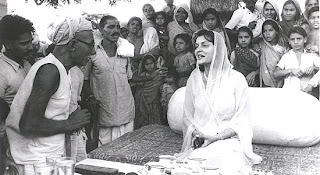
A news ticker running on NDTV yesterday said "Mysore: Photographer TS Satyan dies at the age of 86", and it took me back to my brief interaction with the man. I had never heard of TS Satyan, veteran photojournalist, till I went for a preview of his photographs at the Piramal Gallery in South Mumbai around 1999-2000. I will never forget the incident. Creative people should never be treated in this manner.

I happened to visit the Piramal Gallery about an hour before the scheduled preview that day. I thought I will get some time to chat up Satyan. When I reached there, I saw that the gallery was completely empty. An aging Satyan was very lovingly putting up his pictures on the wall along with photojournalist and my friend Chirodeep Chaudhari. I got a chance to leisurely see his pictures, and have a chat with the man.

Like Satyan, his pictures were simple. Mostly black and white pictures shot in the old school style -- the emphasis firmly on the human expressions, and compositions. Like in this picture of Maharani Gayatri Devi. The picture captures the awe common people felt towards royalty those days. A lot of these pictures were clearly part of a visual history that very few Indian photographers may have captured.

Minutes went by, and it was time for the preview to start. All this while, there were just three of us in the gallery - Satyan, Chiro and me. And, there was no sign of anyone arriving either. Satyan was clearly upset. He never expected that he would be received in this manner by Mumbai's art loving junta. I felt at least the photojournalistic community should have been there to support. I called up a few photojournalists friends. Those who were free at that moment did troop in later. But, Satyan was clearly hurt. He said he will never exhibit in Mumbai again. I don't know if he ever did.

I was also shocked for another reason. Exactly seven days before this, I had come to the same gallery for a much-hyped preview of Prabuddha Dasgupta's exhibition on Ladakh. Before the preview could start, I was standing near the entrance of the gallery with my friend Neeraj Priyadarshi, now Indian Express photo-editor. A well-known socialite (whose name is better avoided) walked in, and obviously mistaking Neeraj for Prabuddha, started complimenting him in a manner mastered only by empty-headed socialites.

Both of us were taken aback, and we politely directed her to go to the first floor gallery. Quite obviously, it turned out to be a socialite gathering complete with wine-and-cheese. The place was buzzing with models, and people from the ad industry since Dasgupta (yes the man who shot Milind Soman-Madhu Sapre Tuff Shoes ad) is a celebrated ad photographer. TV cameras and photojournalists also came in large numbers to cover the event.

The memory of the stark contrast between these two photo exhibitions came back when I read about Satyan's death in Mysore. Undaunted by the response to his Mumbai exhibition, Satyan continued to take his old-world-gentility all around the country, and came up with several collections of his photographs.

Born in 1923 in Mysore, Satyan was one of the early pioneers in Indian photojournalism and shot pictures for publications like The Illustrated Weekly of India, Life, Time, Newsweek. He also shot special projects for Unicef which allowed him to travel widely and shoot rural life, especially the children, from a closer perspective. In 1979, Unicef organised an exhibition of Satyan's pictures of children at the UN headquarters in New York to mark the International Year of the Child. His books include Exploring Karnataka, German Vignettes, Hampi - The Fabled Capital of the Vijayanagar Empire, In Love with Life - A Journey through Life in Photographs, and in 2005 Penguin published his memoirs titled Alive and Clicking. Satyan was awarded the Padma Shri in 1977.

Do check more links on TS Satyan:
A Rediff report
Hindu article
Review of his show, A Long Exposure


Thursday, October 01, 2009

A journey into visual history

The World Press Photo competition is arguably the world's biggest news photography contest receiving over 95,000 images each year, and some of the world's leading photojournalists come together to judge that one image which gets honoured with the World Press Photo of the Year prize.

That the competition is based in The Netherlands is not a surprise. The Dutch have a great tradition of supporting culturally valuable things, going by the way the Vincent Van Gogh and Rijks Museums (which houses the Dutch school of painting led by Rembrandt among others) have been built and managed in Amsterdam.

Indian photjournalists participate each year in large numbers, but India has won the coveted World Press Photo of the Year only twice in the 54 year-old history of the competition. Both for iconic images of tragedy. Delhi-based photojournalist Pablo Bartholomew won it the first time for his picture of a half-buried face of a Bhopal Gas Tragedy child victim in 1984. India won it again in 2005, which was the 50th year of WPP incidentially, for Arko Datta's picture of a woman mourning the loss of her kin in the Tsunami that hit South India.

Today onwards, WPP Foundation has kicked off a new initiative -- an online archive of some 10,000 contest winning pictures that provide a visual record of more than 50 year of human history. The archive will provide each year's prize winners in chronological order since 1955!

The first winner of the competition, started nationally by Dutch union of photjournalists before it went international, was a picture of motor-cross rider tumbling down his motorbike at a competition in 1955.

You can see this one ofcourse, and scores of other iconic images that have won the prizes. For instance, that unforgettable image of a naked girl running away from a napalm attack in Vietnam which arguably changed American public's perspective of the Vietnam war, and forced the government to stop the war. Others including the self-immolation of a Buddhist monk, a defiant Chinese protestor braving the tanks at Tiananmen Square, and James Nachetwey's scar-faced face of the Rwanda ethnic violence.

You could go on this visual history journey